
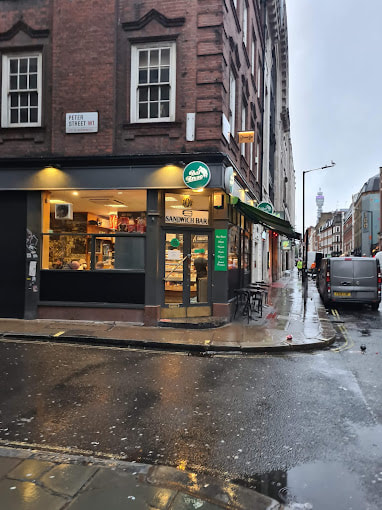
 Bar Bruno, 101 Wardour Street, Soho, London, UK I was listening to BBC the other day and they had a segment on how it is difficult to find a 'caf' in London like you could in the old days. One that was open at any hour of the day where you could get as good cup of tea, a good 'fry up' and lots of white bread. This came from a man who had been involved in the theatre in London for a long time. He said that these cafes were invaluable as you needed somewhere to go after a show at no matter what time in the day or night. I researched this and found only a handful left out of over 20 listings of cafes in the first decade and into the second decade of this century.
BBC went to Bar Bruno at 101 Wardour street in Soho which was started as just a tea, coffee and biscuit place in 1960 and has been established more or less as is since 1978. This spot is an English cafe with a strong Italian influence. The menu here includes a 'full English' breakfast (eggs, bacon, sausage, potatoes, brown beans, blood sausage, mushrooms and toast), many types of sandwiches, chips, bacon rolls, doughnuts, tea, coffee and beer but also paninis and lasagna. This is an all day breakfast spot that opens in the wee hours at 4am but closes at 9pm. Another Soho long established cafe is Bar Italia. It has been around since 1949. The opening hours are from 7am until 5am. However here there are only a few pastries as food offerings. The main event is the espresso. Alcohol is available too. For those who prefer a continental breakfast, look no further than Maison Bertaux which has been an institution since 1871 when French refugees came to London. Soho was the French Quarter of London at that time. Here you can find tea, coffee and fresh pastries from 930am until 6pm. Balans has been a Soho fixture since 1987 when their location at #34 Old Compton Street opened. Their present opening hours are 8am-midnight. It is at their other location on Old Compton Street (#60) that is open until the wee hours: Wednesday and Thursday until 5am, Friday and Saturday until 6am, Mondays and Tuesdays until 11pm and Sundays until 11pm. It open 7 days a week at 10am. They feature an all day breakfast (until 5pm), a lunch and dinner menu and an extensive cocktail, wine and beer menu. They are famous for their 'Porn Star Martini.' There are also 3 other Balans: one in Shepherd's Bush, one in Stratford and one on High Street Kensington. The first two are open 8am-10pm 6 days a week and 9am-6pm on Sundays. Balans on High Street Kensington has slightly longer hours: 8-11 Wednesday-Saturdays and 8am-6pm on Sundays (with Mondays and Tuesdays being 8am-10pm). The menu is the same at all locations. The Golden Hind has been around since 1914 and is on Marylebone Street. It's main dish is fish and chips but services other items -mainly fish dishes. It opens at noon everyday but finishes lunch at 3pm during the week, opening again from 6-10pm. Saturdays it is open continually from noon until 10pm and Sundays it closes at 9pm. London is rich in choice of restaurants but it is sad to see the little family run businesses closing down. It is always wonderful to go into a place that has some history to it, whether in the decor or in the feel of the place. There is so much history in London but most of the traditional eateries are gone. Go try some of the above establishments. Maybe you'll be looking for a late night place to go sometime soon!
0 Comments
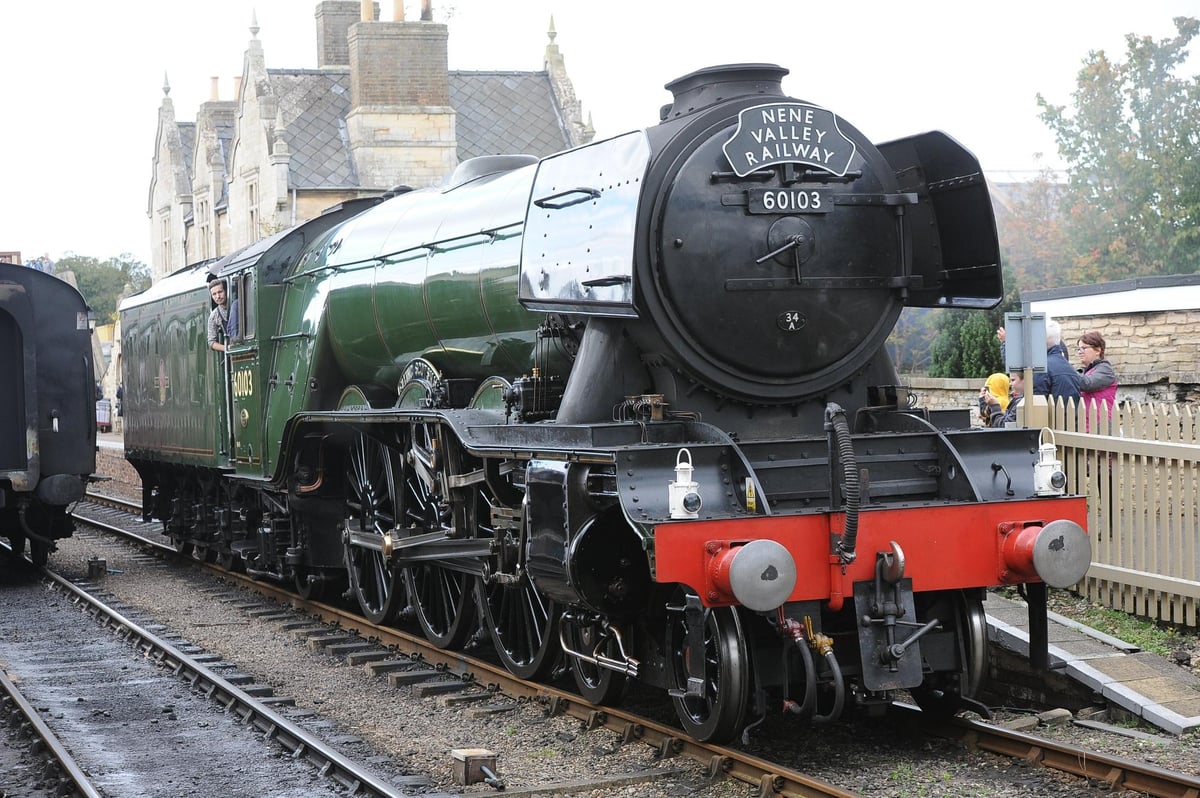 The Flying Scotsman locomotive at Nene Valley Railway
The Brits are train lovers and this is one of the best! The Flying Scotsman is now thought to be the most famous locomotive in the world. It was 100 years old on Feb 24/23 and as such, there are celebrations planned for the rest of 2023. It was the first locomotive of the LNER (London North Eastern Railway) and was the most powerful locomotive used by the LNER at that time. In 1924 it was selected to appear at the British Empire Exhibition in London. It was named the Flying Scotsman after the daily 10am London to Edinburgh rail service which started in 1862. It was made famous at this exhibition. In 1934 the Flying Scotsman went 100 mph which made it the first locomotive in the UK to reach that speed. The colours changed from green to blue during the years but retired with the colour of British Rail Green in 1963. Its last run was 14 January 1963. It had a 40th anniversary run in May 1968 and headed to the USA for a tour in 1969.It was stranded in the USA when the owner went broke but was brought back to the UK in 1973 by a new owner. It got taken to Australia where in 1989 it set a new record for the longest non-stop run by a steam locomotive at 422 miles. Later it had regular runs in Britain including over the famous Settle to Carlisle Railway and hauling the Orient Express Pullman train. There were various crises of ownership, the latest being in 2004 after which a campaign was headed by the National Railway Museum to save it. This was accomplished by donations by the general public, a donation by the Heritage Memorial Fund and the Heritage Lottery Fund which enabled restoration. This year The Flying Scotsman will be travelling all around the UK on differing routes. There will also be a special exhibit at the National Railway Museum on Leeman Road in York. March 1 – 25 – Flying Scotsman at East Lancashire Railway April 1 – 23 – Flying Scotsman on display at the National Railway Museum, York April 30 – Flying Scotsman excursion at Royal Duchy, from Bristol Temple Meads, Yatton and Taunton to Devon and Cornwall. May 1 – 24 – Flying Scotsman to spend a month at the Keighley and Worth Valley Railway on heritage workings June 7 – Flying Scotsman excursion at Cardiff Express through the Thames Valley and along the river Severn June 10 – Flying Scotsman excursion in Chesireman, from London to Chester and back again. June 17 – Flying Scotsman excursion to Portsmouth Flyer, from London to Portsmouth and back. June 21 – Flying Scotsman excursion to Salisbury Express, from London to Salisbury and back. June 30 – July 4 – return excursion along the East Coast Main Line between London, York and Edinburgh June 24 – Flying Scotsman excursion to Great Yarmouth, from London to Yarmouth and back again. July 9, August 6 and September 10 – The Waverley excursion along the Settle to Carlisle line via York, Leeds, Keighley and Skipton August 24 - September 3 – Flying Scotsman at Bluebell Railway in East Sussex. September 10 – Flying Scotsman excursion to Waverley, travelling on the Settle & Carlisle Railway, one of the most famous railway routes in Britain October 14 – The Hadrian excursion along the Settle to Carlisle line via York and Leeds December 16 – Flying Scotsman to spend two weeks in light steam at Locomotion in Darlington Go to the National Railway Museum for more information.railwaymuseum.org.uk What a great year for railway enthusiasts! 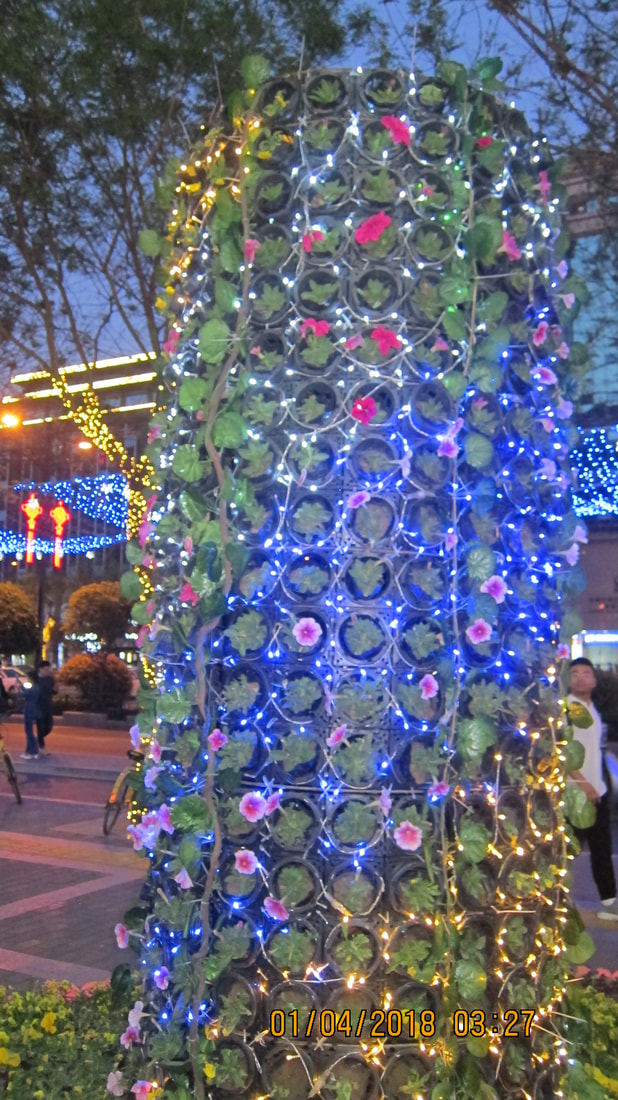 Photo taken in Xian, China where New Years' celebrations include lots of flowers and lights. Their decorations remain for quite a few months.
January 22nd marks Chinese New Year or the Lunar New Year for 2023 and it is bringing in the Year of the Rabbit. This will be celebrated by those from Hong Kong, Taiwan, Singapore, Malaysia, Indonesia, South Korea, and the Philippines as well as those in China. For these countries, the New Year is a time to go back home to visit family. Chinese New Year is celebrated in many other communities around the world that have a significant Chinese population. The Chinese first came to the UK in the 18th Century following the British sailing to China. Due to the docks being in East London, the Chinese first settled in the Limehouse area of East London up until the first half of the 20th Century. Much of the area was bombed in World War Two. In the 1950's and 1960's there was another wave of Chinese immigrants. In the 1970's, Chinese businesses moved to the Soho area. Chinatown is still around Soho, bordering it to the North and West with the Theatre district being to the South and East. Look for Gerard Street and you will be in the centre of it all. There is a Chinese Gate on Wardour Street, opened in 2016. London has the 3rd largest New Year's celebration in the world after Beijing and Hong Kong. Manchester has the 4th largest celebration. Other major communities in the UK that celebrate New Years are Liverpool, Birmingham and Edinburgh. There are also some celebrations in Wales. This year on Jan 22nd, London's parade, which always features a huge dragon and the sounds of gongs and symbols, will be on Charing Cross Road and will go down Shaftesbury Avenue. There will be free stage shows at Leicester Square and food stalls at Trafalgar Square. Go to Visit London for times as they have not been confirmed as yet. Manchester has been celebrating New Years for over 40 years. Celebrations will start on Saturday Jan 21st with street stalls in Piccadilly Gardens. They will be there until Jan 29th/23. The main event is the parade which will be on Sunday Jan 22nd. It will feature the 175 foot dragon that will show itself in the Piccadilly Gardens at noon on Jan 22/23. It will wind its way down to Chinatown. Also featured will be lion and ribbon dances, opera performances, 12 Zodiac animals and Ancient Army characters. Between noon and 7pm on the day will be food and cultural craft stalls as well as live stage performances and two illuminated dragon performances at 5 and 6pm. There will be a final illuminated dragon performance at 5pm on Jan 29th/23 which will start at Piccadilly Gardens and end at Chinatown. Liverpool started putting up decorations for the Chinese New Year celebrations on Jan 9th, 2023. Thousands of lanterns have been erected on city streets and buildings are lit in red around Chinatown and the Chinese Ceremonial Archway. The main event will be from 11am - 5pm on Jan 22/23 at Great George Square. There will be a lion and unicorn parade, firecrackers, tail chi demonstrations, live music, a fairground and a selection of food and craft stalls. Following that there will be a projection show at the Bombed Out Church. Go to liverpoolnoise.com for the full schedule. In Birmingham, the Lunar New Year events are free. Festivities begin on Saturday, Jan 21st with a full day of free performances. The lion procession will be at the Bullring and Grand Central with singing and dancing, drumming and Kung Fu demonstrations. There will be cultural workshops including calligraphy. On Jan 22nd, the celebrations are at Hippodrome Square in the Southside area. Here there will be many family activities including face painting, rides and street food stalls. The opening ceremony will be at 12 noon where the traditional waking of the lion will be followed by cultural dance and music. Fireworks will close the festivities at 5pm. Edinburgh traditionally lights up the Castle in red for Lunar New Year and has a Chinese New Year Gala Concert which features the Edinburgh Symphony Orchestra and Chinese performers, the Qindao Opera House Symphony Orchestra or Chinese Children's Orchestra. Special events are often hosted in the Royal Botanic Gardens and the Edinburgh Zoo. There is an exhibit of Great Lanterns of China presently at the Edinburgh Zoo featuring giant Chinese and Scottish mythical creatures. In Wales, there is a 2023 Chinese New Year and Lantern Festival celebration on Jan 21st from 4-7pm at the Cardiff Central Library Hub. Many activities are planned including mask making, paper cutting, calligraphy, dress try-on, tea tasting, lantern making and traditional music and dance. Swansea's 9-90 Art Club will usher in the New Year on January 21st by participating in traditional Chinese handicrafts such as paper cutting as well as painting, drawing, and collages. Food will be available and families are welcome. If you live outside these areas, check your community schedules for possible events. Alternatively, consider travelling to one of these bigger centres for an enjoyable day out. 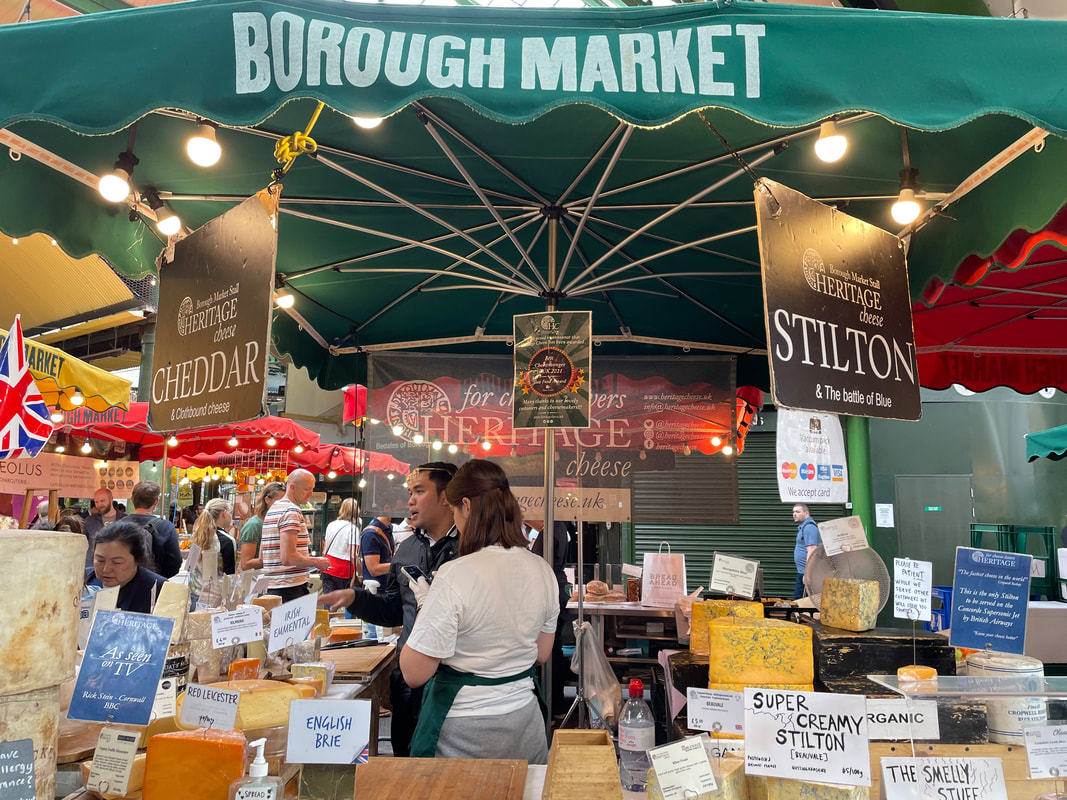 Borough Market, London
England was a country of market towns where people sold, bartered or traded their wares. Most cities had a central square where the markets were held. This was central to daily life and a necessity in order to survive. Many towns and cities in the UK still have market days once or more each week and these are normally held in the town or market square. Despite having supermarkets these days, people still throng to markets. This is where you can still get household goods at a reasonable price as well as fresh local food of all sorts. Vendors come from the Continent to some markets in England and these products are well loved. In a large metropolis such as London, there are markets in many areas of the city. Some specialise in a certain product such as the Columbia Road Flower Market. Many run along the streets and others are held under cover of a building. Some markets are well known such as Borough Market which is known for its wide variety of food. The variety of cheese, breads, ethnic foods, meats, vegetables and everything in between is mind boggling. You could indeed spend many hours here. You can snack, find a spot to sit or take food home. A market was close by at the foot of London Bridge one thousand years ago but the Borough Market moved to its present site by Southwark Cathedral in 1756. Many restaurants have sprung up around it which has expanded the foodie vibe. It is now open 7 days a week. Another popular market is the Portobello Road Market in the Notting Hill area of London. It is known for antiques, silverware, leather and clothes. The market runs along the street and there are indoor shops there as well. There are always food stalls and many ethnic food stands are at the top of the Portobello Road. The amount of people walking up to and along Portobello Road is often quite astonishing, The market itself is not there on Sundays but the shops along the street are open. Another large London market is Camden Market which runs along the Grand Union Canal. It can be reached by 3 metro stops. It covers a very large area. This market has a cross section of food, clothes, and collectibles and is open 7 days a week. All of these markets are crowded on Saturdays and are a joy to be part of. Other notable markets are Old Spitalfields (under cover with lots of clothes, food, books, gifts and designers), Covent Garden ( under cover with homewares, restaurants, jewellery, and often musicians from the Royal Opera House singing), and Greenwich (150 outside stalls on weekends - mostly artisans). In smaller cities you will often hear a cockney accented individual calling out their wares. This makes going to a market in a small town just as much an experience as being part of a large mass of people experiencing the wonders of what a large market has to offer. If you haven't been to a market, make it part of your next journey to the UK. 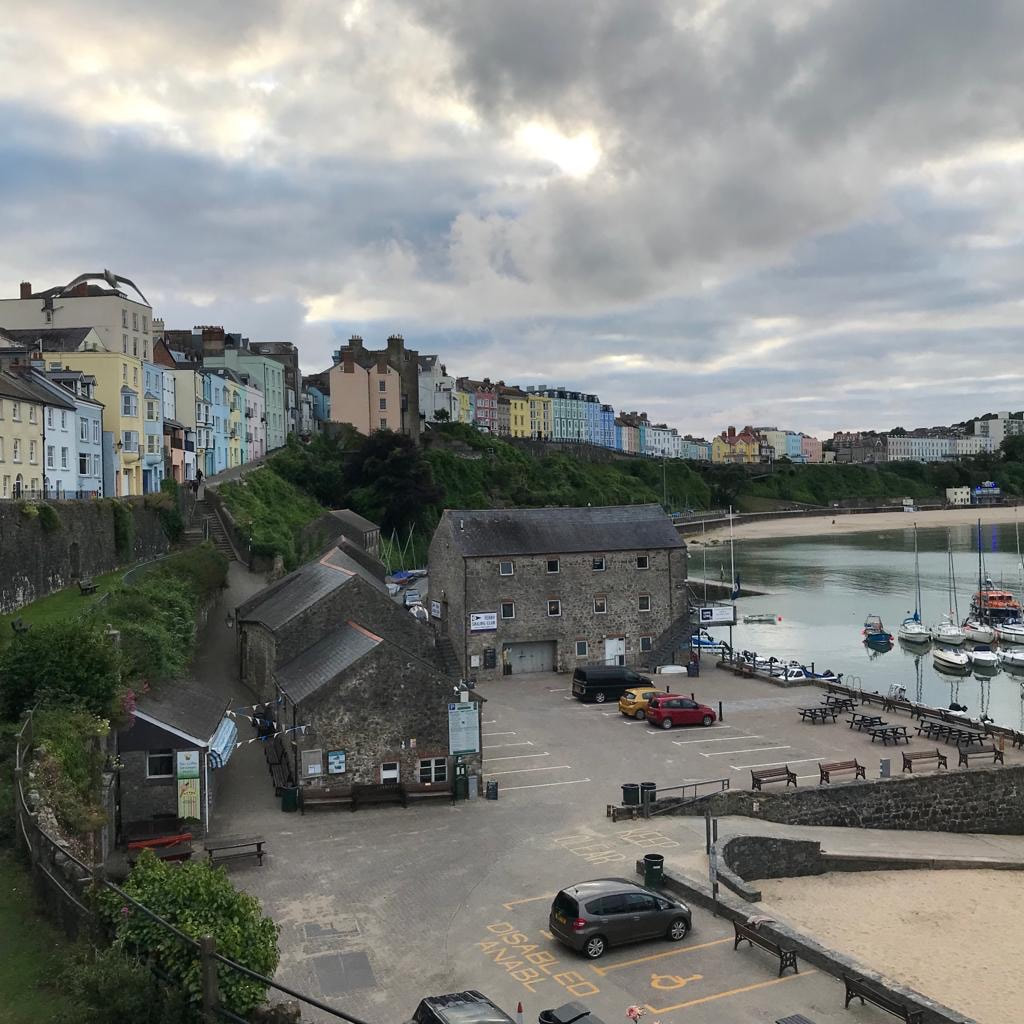 Summer is a great time to think about an adventure in Wales and particularly on the Pembrokeshire Coast. Here you can walk the 186 mile Pembrokeshire Coastal Path or sections of it, enjoy any of the 58 beaches, learn about the history of the castles along the way or visit one of the quaint towns and villages. And the scenery is spectacular! I started my visit in the medieval town of Tenby. Complete with castle ruins and 13th Century walls, this ancient fishing village is now a tourist hub. There are long sandy beaches on both sides of the town and there are lots of very good restaurants. I enjoyed an excellent evening meal every night that I was there! My friend and I took a bus from Tenby centre up the coast to Manorbier which boasts a castle and an old church above the very popular beach there. You can pay to see the castle in its entirety or enter the grounds to eat at the cafe. It was such a treat to have a snack inside the castle grounds and the food is very tasty too! We chose to walk in the direction of Tenby which was on Manorbier's left side. This section is on the southern part of the trail and has some of the most picturesque scenery on the entire path. Some of the more famous sites along this route are Church Door Cove, Sprinkle Haven and Proud Giltar Blowhole. The trail wound along the tops of some very steep cliffs at times but just had a few steep ups and downs. You pass by a Ministry of Defence Rifle Range but it wasn't in use the day we were there. The temperature was perfect and there was no wind! It is always wonderful to find a cafe for a break and past Lydstep is a sign that a farm shop and cafe is just 300 feet off the trail so off we went to find it! If you want to stop your walk here, there is a bus stop just 100 feet up the road. Pembrokeshire has many other castles. We chose to go to the city of Pembroke to see its grand castle. There we were inspired by the excellent tour guide who was very theatrical and painted the history of the castle with aplomb. In the castle courtyard is a map of Wales and on it are placed all the castles in Wales and these are colour coded as to their origins. Many of the castles were build by the Normans who came to Wales soon after the Norman conquest of 1066. They visited and left only to come back later to conquer the lands. Castles, which before this time were not known in Wales, were ordered to be built at this time. Pembroke Castle was started by Arnulf de Montgomery in 1093 who built a bailey and a few years later the people inside the castle withstood a long siege despite being close to starvation. The castle was enlarged by William Marshall, son in law of Strongbow. Both of these names are well known in Welsh history and these men have connections to other castles Wales. Pembroke Castle was built over a cavern and this past two summers, archeologists have been busy digging up bones and flints which date back 10,000 years. A bone, which may be from a wooly mammoth, has been sent away for testing. The archeological team is very excited about this find. My sojourn in Wales was by no means long enough. I plan to return to walk another section of the coastal path and explore more of this beautiful area. I hope that you will plan a journey here too! The photo above is of Tenby. The two photos below are: Top: Manorbier Beach and Castle Bottom: Pembroke Castle's inner courtyard and the map of Wales 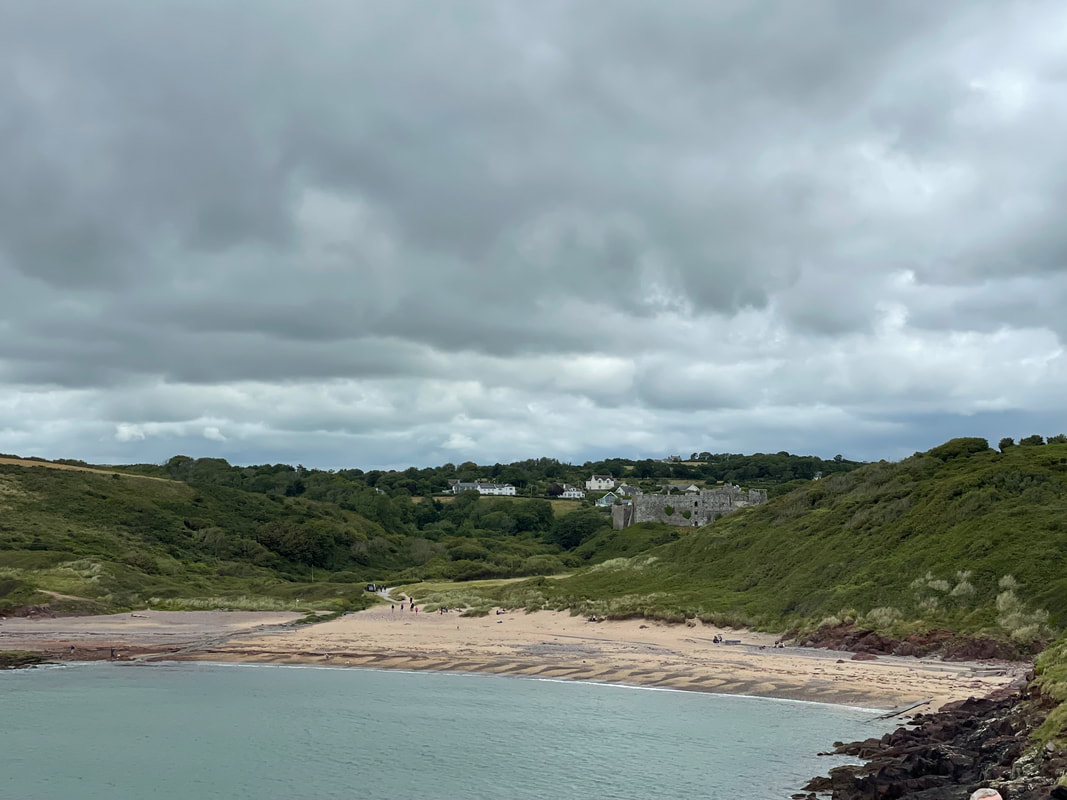 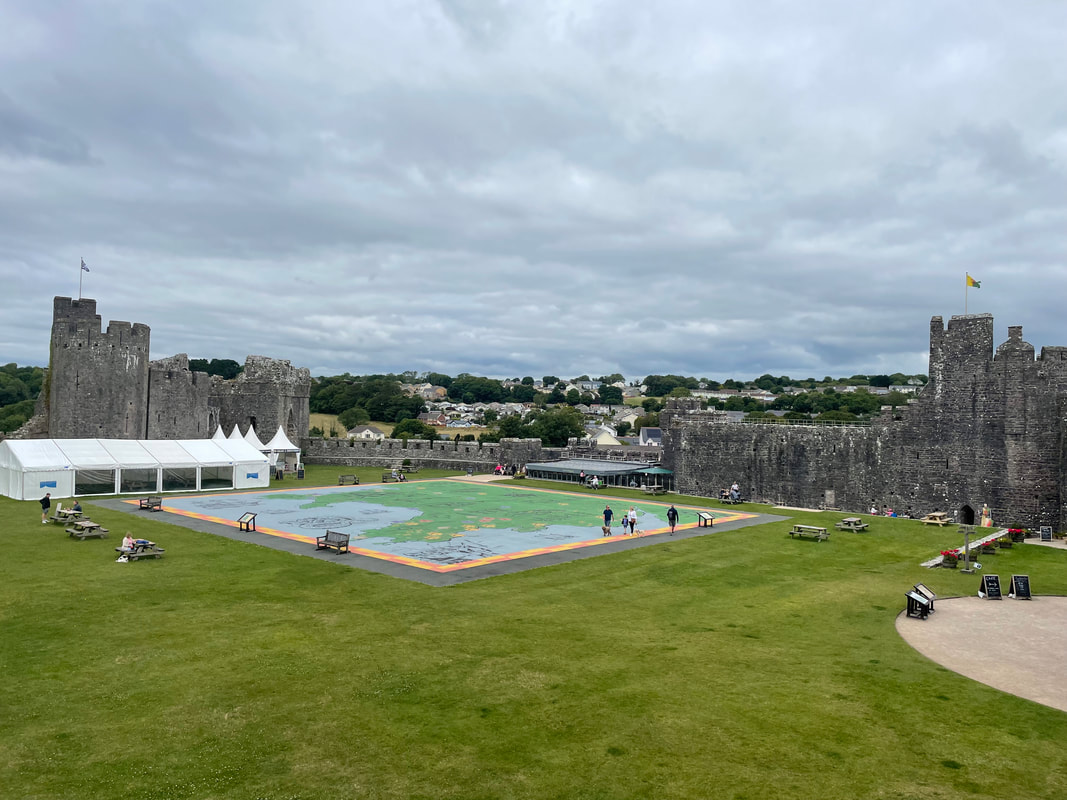 The UK is a country full of great walks. One of the most popular is the walk along Hadrian’s Wall.
When walking in the countryside one has to go by the Country Code. Basically this means that you leave gates and property as they were found and that you take your litter out with you. It is imperative that dogs are under close control as you will pass lots of farm animals en route. In the UK one has rights to cross private property. It is suggested that when walking Hadrian’s Wall path that you have respect for where you are walking and that you don’t walk on well worn sections and that you cross the wall only at recognized rights of way. Hadrian’s Wall dates from AD 122 and there is an AD 122 bus that runs along the route. So this is an alternative way to see the wall if you don’t want to walk it or just take some time out from your walk. Hadrian’s Wall is a remarkable monument from the time of Roman rule in Britain. The Romans wanted to protect the land to the south from the Barbarians in the North as there just weren’t enough military personnel to guard this area. There were already forts at Carlisle and Corbridge which were linked by a road. Other forts were established at Vindolanda and at Nether Denton. In AD 117 Hadrian decided to build a wall north of the Stanegate in the east as far as the new bridge Pons Aeluis across the Tyne and in the west beyond Carlisle to Bowness. The height was probably 5 metres with milecastles at regular intervals and in between these a pair of turrets. Eleven more forts were built at 7 mile intervals. The wall was stone for about 43 modern miles but was often of turf. The base was initially 20 feet wide at the base. The width changed to 7.5 feet later probably due to practicality. At one point the limestone could not be dug through and the crags were left to act as the wall. The walk now has parts of the ancient wall, some turrets, milecastles and temples along part of the route. As well you can discern where the ditches and vallums were dug alongside the wall that were used for protection. Close to the route various forts have been discovered and you can walk through the encampments where the Romans lived and view the items from their everyday life that have been found. The wall runs from Bowness-on-Solway in the west to South Shields in the east. One can start at either end or just take in sections at a time. You can spend a week or more walking the entirety of the wall and is you wish, you an engage a company to arrange your accommodation and to move your luggage as you go. Many people drive to certain sections or to the forts for a day out or a weekend getaway. Popular destinations along the route are the forts that have been discovered. These include Corbridge, Vindolanda, Great Chesters, Vercovicivm (Housesteads) and Birdoswald. Close to the Wall Lanercost Priory is a popular visitor’s spot. There is also the Roman Army Museum near Gilsland A good place to see a section of the wall is at Heddon-on-the-Wall close to Houghton. The Brunton Turret is the best example of a turret that remains on the wall. Some of the best scenery is at Housesteads. In this area can be found the often photographed Sycamore Gap. A suggested walk would be to start from the Segedunem Fort at Wallsend just a short metro ride west of Newcastle. This fort has a viewing area and museum. There is a map of the Wall so is a great place to get an understanding and an overview of where you will be going. Get a guide book that explains where to walk. The first day follows the bank of the Tyne River until you are away from Newcastle. It will be time to make it a day so I would suggest leaving the walk and heading west to Wylam for the night. Get back to the Hadrian’s wall walk in the morning and head towards Heddon-on –the-Wall. This is the first substantial piece of wall since Wallsend. There will be much to see today. The Temple of Mithras and the best remains of a turret , The Brunton Turret are on this route. There are lots of remains of vallums and ditches. You can end your day in the village of Wall which is a bit off of the Hadrian’s Wall walk or you could choose to walk south to the fort at Corbridge first. The third day is a long walking day but there is the best scenery and landscape including the most photographed site on the walk - the Sycamore Gap. You start the day passing Chesters Fort and a Roman bridge. There is the fort at Housesteads to see this day as before a well deserved rest at Twice Brewed or at the hostel next door where there is a brew pub. For the fourth day there is lots to choose from. Firstly, the fort of Vindolanda is a mile or so from Twice Brewed. Then Great Chesters is on the walk today and the Roman Army Museum as well. The day ends at Gilsland. The fifth day has Birdoswald fort as a point of interest and a detour to Lanercost Priory for which stones from Hadrian’s Wall were taken to build it. Newtown can be the end of this day. The sixth day will take you to Carlisle. This is a short day – only about 4 hours. There is not much in terms of the Hadrian’s Wall to see on this section but it is very pleasant through fields and villages and is quite flat. It is strange to see a city again after not having seen too much civilization for a few days. Be sure to visit the castle and Cathedral there. From Carlisle to Bowness it is about 14 ½ miles so it can be done in one day. You will see an entirely different landscape today as you view the Solway Firth. It is very flat for the most part but there is a steady climb up a hill at one point. You do see where a fort was at Drumburgh and the road passes Drumburgh castle which was really a fortified house. Part of the walk goes along where the vallum was. The walk ends at the sea. My companions and I took the train to Newcastle where we spent the night at the Thistle County Hotel across from the train station. Other hotels were the Bistro En Glaze Guest House in Wylam, the Hadrian Hotel in Wall, Twice Brewed Inn, Bardon Mill, Hexham, The Samson Inn in Gisland, Orchard House in Newtown and Hallmark hotel in Carlisle. The luggage was moved every day for us. Arrangements by Let’s Go Walking. I would highly recommend this walk and do it with friends or family.  Spring in the UK means flowers starting first in the south of England. People's gardens are in bloom and all the countryside becomes green. People flock to parks, commons and green spaces. It is a joyous time of year. There are festivals all over the UK in Spring from art, music and flower shows to sport and a plethora of things to take part in. National Trust properties offer festivities and other agencies such as Bletchley Park widen their availability of events. This Spring is no exception. On April 16th, during Easter weekend, the Betfred World Snooker Championships begin in Sheffield at the Crucible. They continue until May 2nd. Other sporting events include the FA Cup Final on May 14th and the Women's FA Cup Final on May 15th (both at Wembley Stadium), The European Taekwondo Championships in Manchester from May19-22 and the FIH Hockey Pro League from May 21st until June 19th in London. The Betfred British Masters Golf tournament will take place at the Belfry in Sutton Coldfield from May 5th - 8th. Art Festivals are popular around the UK. Two of these in May are Upfest in Bristol on May 28th and May 29th and the Norfolk/Norwich Festival from May 13th until May 29th. The Norfolk Festival takes place all around the area in public places. Music Festivals this Spring include Cheltenham's Jazz Festival April 27th-May 2nd and Liverpool's Sound City from April 30th to May 1st. Salford's Day Festival Sounds from the Other City is on May 1st. The Bath Festival, a celebration of literature and music, runs from May 13-22nd. An event celebrating history is the Jorvik Viking Festival in York. It takes place from May 28th until June 1st. Hastings celebrates May Day at the traditional Jack in the Green festivities from April 30th until May 2nd. Other types of Festivals include Padstow's ancient festival called Obby Oss on May 1st, Photo London at Somerset House in London from May 12-15th, the Plymouth Pirates Weekend (May 7th and 8th), and the Brighton Fringe and Festival from May 6th which lasts for 3 weeks. Long running festivals include Tom Kerridge's Pub in the Park on selected dates from May 12th - Sept 18th which is a national foodie festival and the Birmingham Festival which runs from the end of May until October 31st. A famous but long lasting unusual tradition is the Cooper's' Hill chase of the Double Gloucester cheese wheels down a hill. You can participate or watch this event. When it comes to flowers, the UK's most famous flower show, THE RHS Chelsea Flower Show, takes place this year from May 24-28th. Anyone who enjoys looking at gardens or creating them will enjoy this event. Last year it took place in September due to the pandemic and it was attended by so many with so much enthusiasm after not taking place since 2019. In Scotland there is Bonfest near Dundee at Kirrriemuir. Go to Bonfest.com for information re: tickets and camping options for the weekend of April 29-May 1st, 2022. In Northern Ireland in North Antrim at Ballycastle, the locals expect to have the Rathlin Sound Maritime Festival at the end of May each year. The dates have yet to be announced for 2022. Events are for boating enthusiasts as there is a sailing regatta, curragh racing, and Tall ships and Viking ships to see. There is always lots to tempt foodies on the shore. Go to one of these events, walk in the outdoors or just enjoy new blooms as you are out and about this Spring! 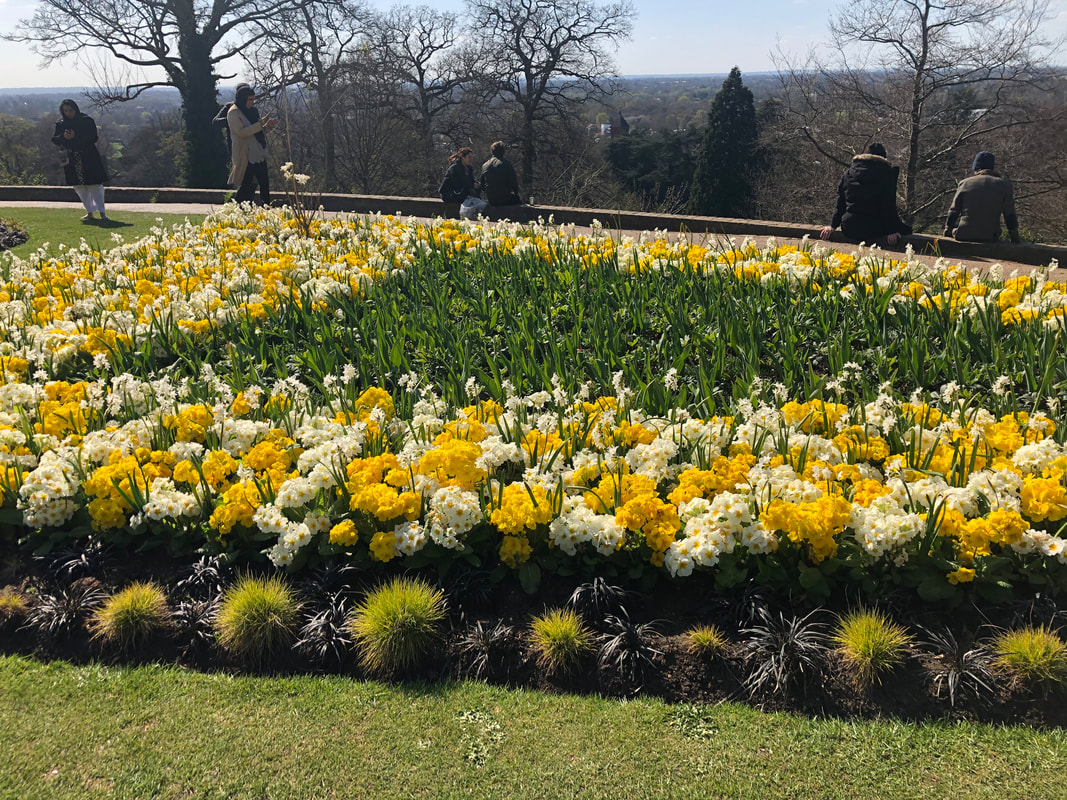 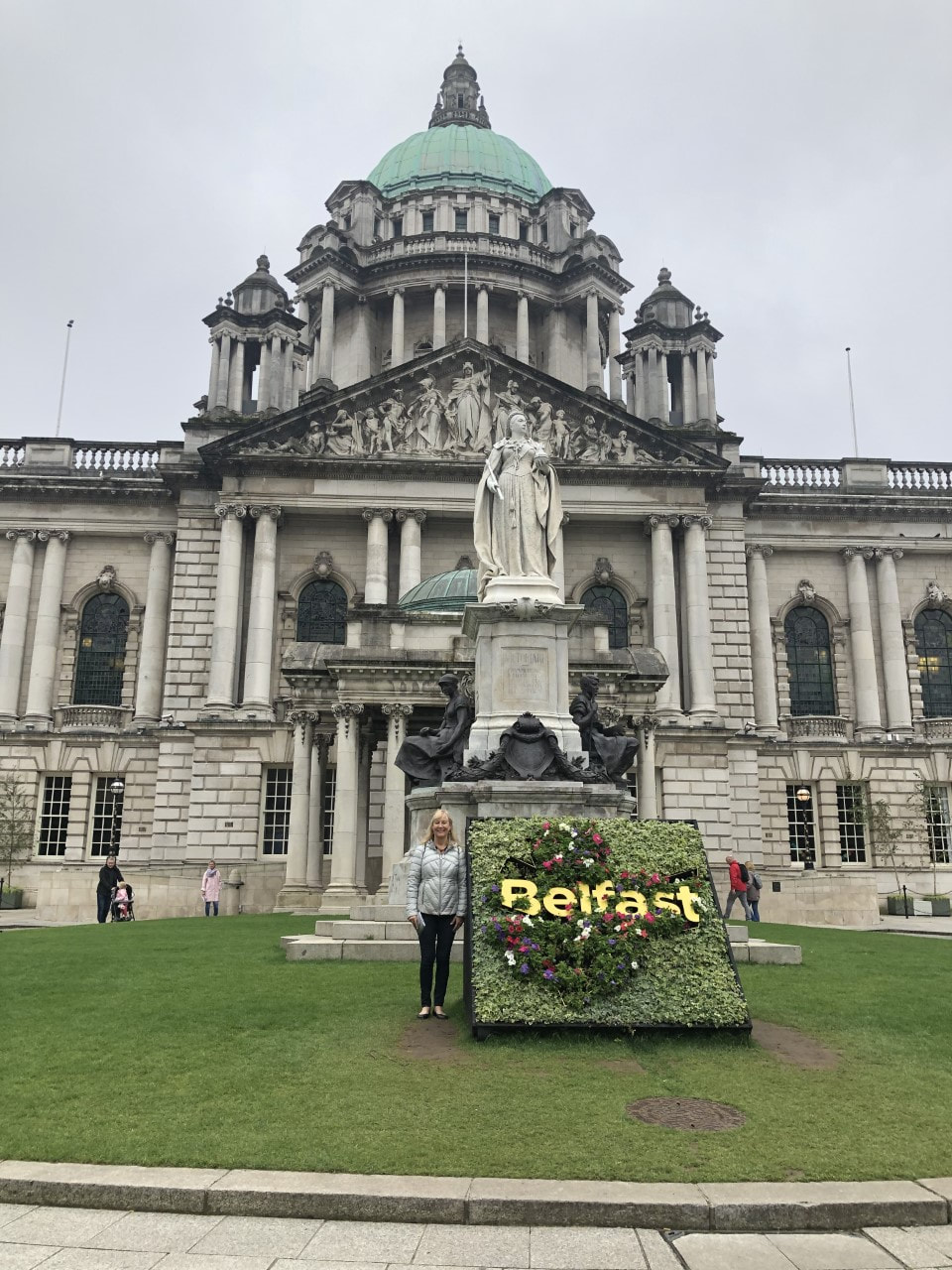 Above: Belfast City Hall
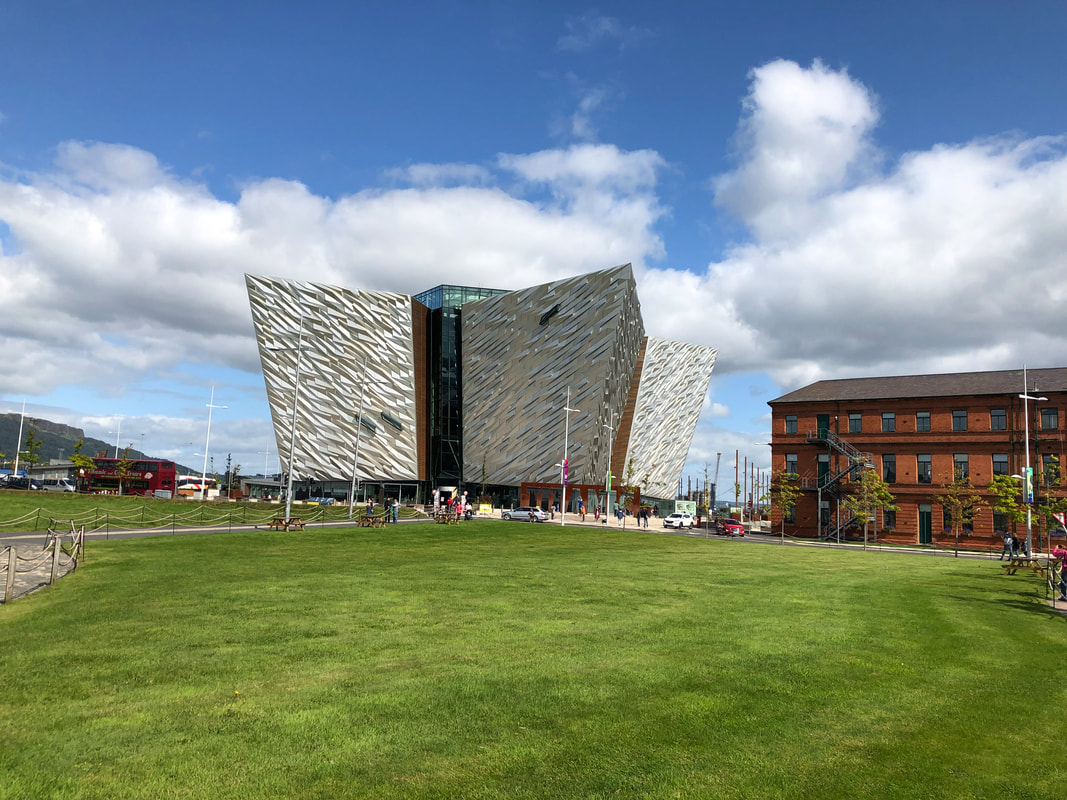  As we have just passed the Hallowe'en and All Saints Day celebrations, this is an ideal time to discuss haunted Britain.
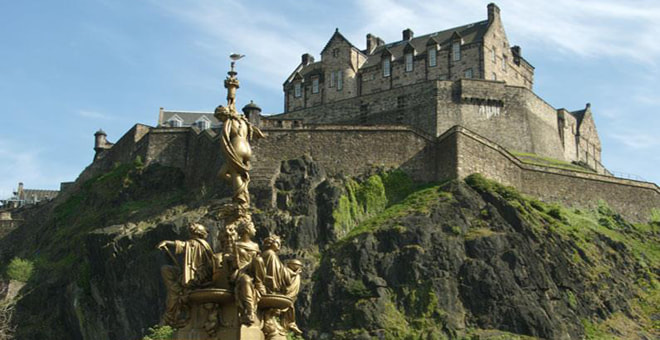
The UK has the most visitors of anywhere in the world in normal times (other than a pandemic such as in 2020). People go to see the historical sights that are part of our shared cultural heritage, to get that old world feeling and to visit those places which have an old world charm. The small villages are quaint and cozy and the countryside is uniquely beautiful. The reality of the past is much different. There was much poverty, dirt and disease coupled with brutal murders, tortures and other grisly deaths. For these reasons, it was thought that many people would have unfinished business on the earth that they left behind due to sudden and unforeseen ends to their lives. The ghosts of these people are thought to continue to roam around the place where they were killed or was a special spot for them. There are an abundance of places in the UK that are famous for ghost sightings today. I will discuss some of these below. SCOTLAND From people being murdered and sold to the medical school for experimentation to a very sordid past in a poverty stricken and disease filled area, Edinburgh has the ingredients for an infatuation with all things ghostly. There is also THE CASTLE on THE ROCK where people have lived since 850 AD (photo above). There have been wars fought there such as the Wars of Scottish Independence in the 14th Century and the Jacobite Rising in 1745. It has the reputation as the most besieged castle in Great Britain. Not surprisingly there are reports of being touched or pushed, sudden cold temperatures, the feelings of unseen beings being present, and apparitions being seen by staff and visitors alike. Another popular tourist attraction in Edinburgh is the ghost walk through the vaults where there were at first businesses but later these were taken over by very disreputable people and even body snatchers. You can even spend the night from midnight to dawn Thursday to Saturday nights during the Edinburgh Festival in August each year. Tourists have reported seeing or feeling strange activity in these underground caves. Other places in Scotland include: -In Glasgow at the Necropolis, there is still a rumour today that a vampire killed and ate two local boys. It is known as the Gorbal's vampire. This rumour comes from the 1950's when hundreds of children, armed with knives and sticks, were patrolling the graveyard after saying they heard the vampire -At Crathes Castle there have been reports of the sighting of a green lady. This was even reported by Queen Victoria. -St Andrew's Cathedral is haunted by two ghosts. One is a friendly monk who is seen on the stairs and the second is a beautiful lady in white. There have been reported sightings of her for over 200 years. -At the field of Culloden, where the massacre of the Jacobites occurred, there are reports of cries, sword clashes and gunfire as well as a Highlander who is said to be heard saying 'defeated.' -There have been many sightings of ghost figures at the Skaill House on the Orkneys which was built on a Pictish burial ground. WALES There are sightings at various spots in Wales, notably at Inns, small towns and castles such as the following: -The Skirrid Mountain Inn in Monmouthshire is said to have been a court where 180 criminals were found guilty and hanged many years ago. The Inn sees ghostly visitors. -The Newton House in Carmarthenshire was built in Medieval times on a site which has been known to have people on it for 2000 years. There was a murder here of Lady Cavendish who was strangled by a suitor. Films have been made here and a cameraman once felt an invisible pair of hands squeezing his throat in the very room where the murder is said to have happened. There have also been reports of lights switching on and off, muffled voices, cold spots and cigar smoke when no one was smoking. -The Town Inn in Llanrhidian has had reports of the ghost of a coachman sitting in his favourite spot at a table ear the front window. -In Rhossili, a small village in the Gower Peninsula, a mysterious couple in Edwardian dress is seen walking around. A phantom is also seen galloping across the sand who is said to be the spirit of Rev John Lucas who lived in the area long ago. In the rectory, an overnight visitor felt a sudden chill, heard footsteps and a mocking voice saying 'Why don't you turn around and look at me?' -At Swansea Castle, there are sightings of a woman in blue. -In Pennard Castle a shrieking banshee is frequently seen in the ruins there. NORTHERN IRELAND The Irish are well known for their beliefs in visits from people from their past and messages being sent from the beyond. Their stories and songs often feature ghosts and banshees. One spot to visit is at Springhill in Londonderry where the ghost of Olivia roams a house where she died. She loved children and during the day her ghost can be often seen standing on the stairs and strange knocking noises are heard coming from the nursery. ENGLAND There is SOOOOO much history in England and as such there are many places known for visits by past residents or those who suffered violent deaths. They are in many of the counties such as the following: Lancashire Pendle Hill at Lancaster Castle is a Hallowe'en spot due to the renowned 12 Pendle Witches who were hanged there in 1612. Devon Berry Pomeroy Castle is said to be the most haunted castle in Britain. There is said to be a blue lady who lures people and a white lady who haunts the dungeons. At Buckland Abbey, Sir Francis Drake's ghost has been seen. Northumberland The blue boy is the famous ghost who haunts the Pink Room in the Chillingham Castle. Kent In the village of Pluckley, which has the reputation of being the most haunted village in Britain (according to the Guinness Book of Records), there have been 12 reported ghosts. Some of these reported ghosts are a highwayman, a phantom of an old woman and that of a school master. Hampshire At the Vyne, a National Trust property, there have been lots of stories from staff about hearing a man's voice and footsteps. One volunteer said that she was pushed. A mysterious woman in grey has been seen in the chapel. Somerset Strange apparitions have been seen in Dunster Castle which include a man in green walking through and then disappears without a trace. Norfolk Anne Boleyn, who is thought to have been born at Blicking Hall, is said to appear headless every year on the anniversary of her death (May 19). There is said to be a phantom in the library at Felbrigg Hall. Dorset At Corfe Castle, Edward the Martyr was murdered on the order of his step-mother. Also there were 22 French prisoners starved to death in the prison there. It is said that a headless woman in white, who betrayed a royalist family who were living there, stalks the halls. Essex Borley Rectory is said to be the most haunted mansion in Britain. There are ghost stories about this place that stretch over 100 years. Apparitions are seen around the grounds as well. Surrey Ham House is a really haunted mansion. In the 17th century, the occupant of the house, Elizabeth Murray Maitland, played both sides of the political divide, being friends with both Cromwell and Charles the second. She and her second husband lived there. People who volunteer at this National Trust property talk about an oppressed atmosphere on the main floor and a woman in black screaming from time to time. Yorkshire The Treasurer's House in York is said to be haunted by ghosts of soldiers. A few years ago, a man was installing a central heating boiler and heard a sound of a trumpet and saw the top of a soldier's helmet emerging from the wall. He leapt from his ladder and then saw a horse and 20 soldiers going 2 x 2 carrying lances, round shields and swords. A curator said "Oh you have seen the Romans." It was found that there was a Roman road in the 4th Century under where the treasurer's house is. There was a dispute as the Romans were thought to have square shields but it was found that in the 4th Century, the Roman shields were round. In London 1. Highgate Cemetery From the 1970's until 2013 there are reports of a Victorian dressed man floating through the park. 2. Hampton Court Palace Catherine Howard and Jane Seymour, two of Henry the 8th's wives who died in the palace, are said to be seen walking in the courtyard and walking with a candle. ......................................................................................................................................................... As you can see there are so many interesting places to visit if you are looking for a haunted place. When we all can go travelling again these fabulous places can be visited 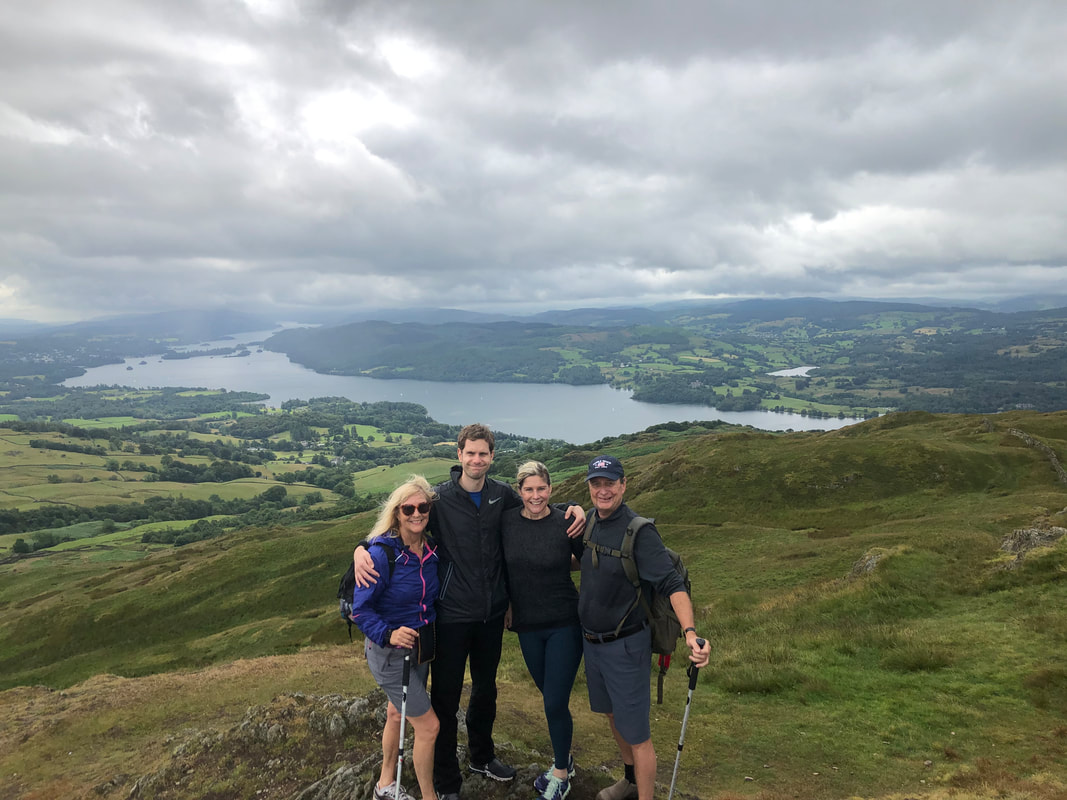 At the moment, people are looking for what to do at home during unexpected free time or during their holiday leave this year.
Being outdoors is safe so why not GO WALKING! Walking is a great national past time for Brits. There are trails everywhere so one is spoiled for choice! There is so much history around the UK that you can walk following historic paths or you might just happen upon places of historic interest. There are National Trails, National Parks, National Forests and Coastal paths. You can go for an afternoon or for a week or longer if you wish. National Trails include the Hadrians Wall Path which has its own Post on this site already. There are many more National trails to choose from including the Yorkshire Wolds Way, The Cotswold Way, the Thames Path and the South Downs Way. Other National trails are also Coastal trails such as the South West Coast Path, the Pembroke Coast Path and the Causeway Coast Way. Other Coast Paths include the Norfolk Coast Path, the Northumberland Coast Path, the Cumbria Coastal Way, the Fife Coastal Path, the Pembroke Coast Path, St Oswalds Way, the Somerset Coast Path, the Hebridean Way and the Solent Way. Jersey has its Coast Path as do the Isles of Scilly. Some paths are along canals such as the Oxford Canal trail or the Grand Union Canal walk. You can follow paths named after writers such as the Coleridge Way, Heriot Way or Shakespeares Way. Some are after Saints such as St Cuthberts Way or Saints Way. These are all Moorland or Countryside walks. Others in this category include Dartmoor Way, Jubilee Trail, Leland Trail, Two Moors Way, White Horse Trail, Peddars Way, Pilgrims Way, Richmond Way, Tarka Trail and Yorkshire Wolds Way. There are some very popular walks such as the Rob Roy Way, the Great Glen Way, the Loch Ness Circular and the West Highland Way in Scotland. In Wales, Glyndwr's Way, the Wye Valley Walk, the Severn Way and the Offas Dyke path are classic walks. There are certain areas that some people go to just for the walking. These include the Lake District and the Peak District. Both of these are National Parks. For a National Forest Walk, try the National Forest Way which is north west of Leicester and north east of Birmingham. It is a 12 stage 75 mile walk. You can go to a site such as LetsGoWalking.com to get further inspiration. They will organize a walking holiday for you if you so desire. There are mountains to climb too. These will be featured on another blog post. Until then, Happy Walking! |
Categories |
 RSS Feed
Proudly powered by Weebly